By 1918, most American women still lacked the fundamental right to a political voice. Depending on the State, women might or might not be able to vote in local, state or federal elections. And Congress – like the country – remained divided.
But the President had finally publicly encouraged passage of the federal Amendment. And the House passed the bill in April — so this year might be different? But will the Senate do the same?
In September, 1918, Elizabeth Kalb arrived to help push that answer to “yes!”
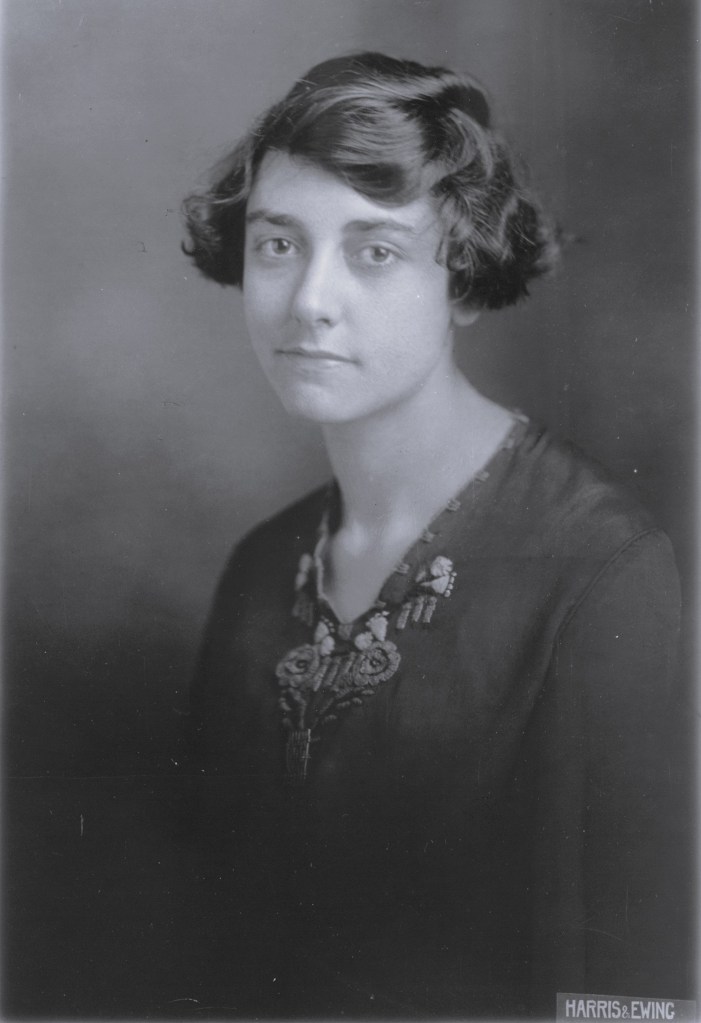
Hildegard ELIZABETH Kalb Green Handy
1896 – 1973
BA, Rice Institute [now Rice University], 1916
Writing Classes, University of Chicago, 1917 – 1918
Staff, National Woman’s Party, 1918 – 1921
Secretary, CA Women for LaFollette for President, 1924
Reporter, American Committee for Fair Play in China, Peking [Beijing], 1925 – 1926
Editor, Pacific Affairs, Hawaii, 1927 – 1933
Writer and Farmer, Oakton Virginia, 1936 – 1973
Exploring the life and letters of Elizabeth, we see history writ large. A modest, middle-class girl, she dreamed of being a writer. Instead, she became a minor player in a series of major 20th century movements. Her writings provide an eyewitness account of American history, as do the surrounding truths that she did not convey.
The question of who participates in democracy was a source of controversy from the start of the new nation. John Adams wrote the following in 1776, disagreeing with a colleague sympathetic to broadening voting rights:
“Few men, who have no property, have any judgment of their own. They talk and vote as they are directed by some man of property, who has attached their minds to his interest. Depend upon it, sir, it is dangerous to open [such a] source of controversy and altercation, as would be opened by attempting to [change] the qualifications of voters. There will be no end of it. New claims will arise. Women will demand a vote. Lads from 12 to 21 will think their rights not enough attended to, and every man, who has not a [dime], will demand an equal voice with any other in all acts of state. It tends to confound and destroy all distinctions, and [surrender] all ranks, to one common level.”
— John Adams, “John Adams Explains Why People Without Property Should Not Be Able to Vote,” SHEC: Resources for Teachers, https://shec.ashp.cuny.edu, accessed July 30, 2023. EMPHASIS ADDED.
So suffrage – an individual’s most basic voice in an elective government – was not originally protected. The resulting history of voting rights is a constant shift in priorities, fears and power. That history also is a testimony to those with and without property, of all races and genders/gender identities, who fought for the rights of people to have a voice.
 Eye-Witness History